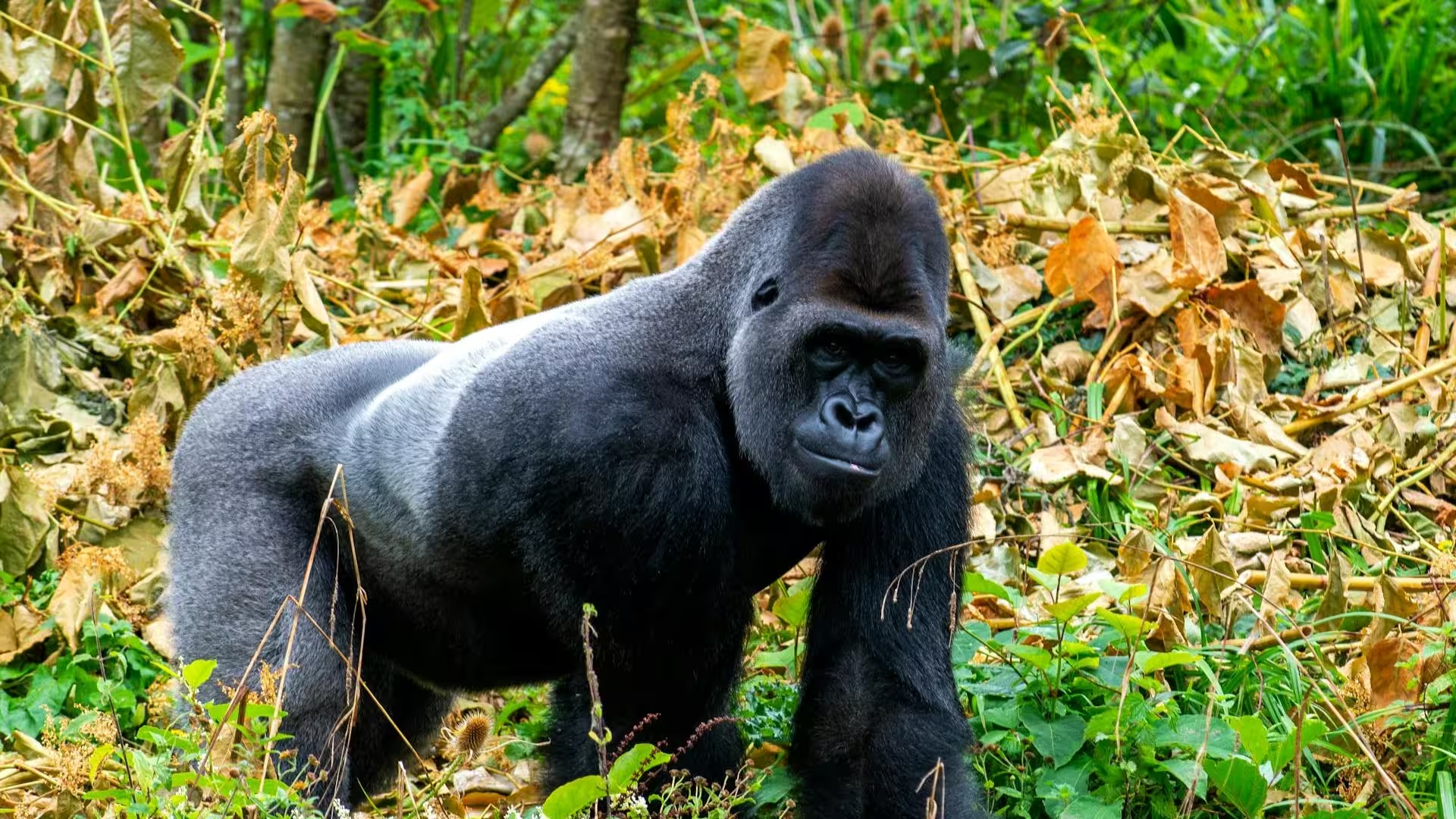
You are standing on a muddy trail in a mountain forest, ten minutes into your hour with a gorilla family. A silverback stops eating. He stares, rises onto his back legs, and drums on his chest. The sound rolls through the trees like a hollow knock on a very large door. Then he drops forward and runs straight at the group.
Your heart will do something. That is normal. But in almost every case, what you just saw was a display, not an attack. This post explains what the chest beat means, why gorillas charge, and what to do if one runs at you.
The Quick Answer
- The chest beat is a signal. It shows size, warns rivals, and tells the troop where the silverback is.
- The charge is usually a bluff. The gorilla stops short, veers off, or slaps the ground.
- Real attacks on visitors are very rare. Park rules and experienced guides exist to keep them that way.
What Is Actually Happening When a Gorilla Beats Its Chest?
The move looks simple. The gorilla stands upright, cups his hands, and slaps them rapidly against his chest. The sound is deep and hollow, and it carries a long way through dense forest. Part of the noise comes from the chest itself, which acts like a drum.
The chest beat is rarely a stand-alone act. It sits inside a longer display with a rough order. A gorilla might start with soft hooting, then hoot faster. He may tear off a branch or a handful of leaves, stand, beat his chest, run sideways, and finish by slapping the ground. Not every display includes every step, and a gorilla can stop at any point.
That order matters. It tells you the gorilla is performing, not losing control. Each step gives anyone watching a chance to back off.
Why Do They Do It?
Scientists still argue about how much weight each reason deserves, and gorillas probably do it for more than one reason at once. These are the main ones.
To show off size
A chest beat shows a rival how big and strong the gorilla is. Gorillas read the sound and the sight together. In many cases the other male gets the message and leaves, and no fight happens. For an animal that can seriously injure its own kind, avoiding a brawl is a smart trade.
To warn off a threat
A silverback uses the display to say “come no closer.” This works on rival males, on unfamiliar groups, and sometimes on visitors who have drifted too near.
To keep the troop together
The sound carries through thick forest where gorillas cannot always see each other. Troop members hear it and know where the silverback is. It works a bit like calling out in a crowded house.
To impress females
Display plays a part in how males show off to the females around them. A strong, confident performance matters in the long run, though this is one of the harder reasons to measure.
Because they are excited
Gorillas do not only beat their chests when angry. Young gorillas do it during play, and the sound can mean excitement as much as warning. This is why context matters when you read the behavior.
Who Beats Their Chest?
Silverbacks do it most often and loudest. Blackbacks, the younger adult males, do it too, and juveniles copy the move while they play. Infants imitate the adults around them, and watching a toddler-sized gorilla thump a tiny chest is one of the best things you can see on a trek. Females beat their chests less often and less forcefully.
Mountain gorillas and lowland gorillas both do it. Some details of the display differ between types, but the idea is the same.
What a Charge Looks Like
A charge usually starts with the display. The gorilla hoots, stares, beats his chest, then bursts forward at speed. It looks terrifying, and it is meant to.
Most of the time, it is a bluff charge. The gorilla runs toward you, then stops short, veers sideways, or slaps the ground and turns away. He made his point without making contact.
A serious charge looks different, though it is far rarer. There is little or no warning display, the stare is fixed, and the approach is direct and silent. Experienced guides can tell the two apart, which is one reason you should always trek with them and never alone.
What Sets Off a Charge?
Most charges have a clear trigger.
Rival males. Outside silverbacks are the biggest cause. Charges between gorillas happen far more often than charges toward people.
Surprise. A startled gorilla reacts fast, so sudden noise or movement raises the odds.
Getting too close. Crowding the troop, especially the young, pushes past a comfort zone.
Protecting infants. A silverback acts quickly if he thinks the babies are at risk.
Reading a visitor as a threat. Direct eye contact and abrupt movements can look like a challenge to a gorilla.
Habituated gorilla families, the ones used for visits, tolerate people well. Rangers also learn each family’s moods and know when to give a troop extra space.
If a Gorilla Charges at You
Almost no one who trekked with a good guide ever needs this. Still, it helps to know what to do before you need it.
- Stay where you are. Do not run. Running can trigger a chase and gives the gorilla no reason to stop.
- Crouch down slowly. Making yourself smaller tells the gorilla you are not a challenger.
- Look away. Direct staring reads as a challenge. Keep your eyes lowered.
- Stay quiet. No shouting, no sudden moves, no grabbing for a camera.
- Let your guide take over. Rangers often make low, soft grunts that tell the silverback you mean no harm.
- Keep your group close. Stay together and calm, and wait for the guide’s signal before you move.
Why does this work? The gorilla is checking whether you are a threat. A still, lowered, quiet person is not one. Every park and guide has their own rules, so follow your own briefing first.
How Trek Rules Keep Everyone Safe
The rules are built around this exact behavior. Groups stay small, with a maximum of eight visitors per family. You get one hour with the gorillas. Guides tell you to keep roughly 7 meters (23 feet) away, though gorillas sometimes close the gap themselves, and then you simply step back slowly.
You keep your voice low. You do not use flash. You do not eat or drink near the gorillas. And you stay home if you are ill, because gorillas can catch human illnesses, and a sick visitor can put a whole family at risk.
Do Gorillas Ever Really Attack?
Attacks on visitors are very rare. The few reported incidents in the past involved unusual circumstances, and the systems in place today are designed to avoid them.
Most injuries in gorilla conflicts happen between gorillas, not to people. A display that ends in contact is usually a rivalry between males.
Still, gorillas are wild animals and no one can promise how one will act. That is why guides, group limits, and distance rules exist.
Do Other Apes Do This?
Chimpanzees have their own charging displays, and they are faster and louder than a gorilla’s. A chimp display can include screaming, stamping, dragging branches, and sprinting along the ground. Chimps do not beat their chests in quite the same way gorillas do.
For a closer look at how the two apes compare, read our guide to gorillas vs chimpanzees.
Where You Can See This Behavior
You can track gorillas in Bwindi Impenetrable National Park and Mgahinga Gorilla National Park in Uganda, and in Volcanoes National Park in Rwanda. You may see chest beating on a trek, but no one can promise it. Some visits are calm from start to finish.
Permit prices change, so check current rates when you plan. For more on the animal at the center of all this, read our silverback gorilla facts.
Questions People Ask
Why do gorillas beat their chests?
It is a signal. It shows size, warns rivals, keeps the troop together, and sometimes expresses excitement.
Are gorilla charges dangerous?
Most are bluffs and end before contact. Following your guide’s instructions keeps the risk very low.
What should you do if a gorilla charges you?
Stay put, crouch slowly, look away, and keep quiet. Let your guide handle the response.
Do female gorillas beat their chests?
Yes, though less often and less forcefully than males. Young gorillas do it during play.
How loud is a gorilla chest beat?
Loud enough to carry a long way through thick forest. Up close, it feels more like a deep thud than a clap.
Have tourists been hurt by gorillas?
Incidents are very rare. Group limits, ranger supervision, and distance rules are all designed to prevent them.
Final Thoughts
The next time you hear that hollow drumming in a forest, you will know what it means. The gorilla is not out of control. He is talking, and he is talking loudly, to rivals, to his family, and to you.
Ready to meet them? View our gorilla safari tours or request a custom itinerary.